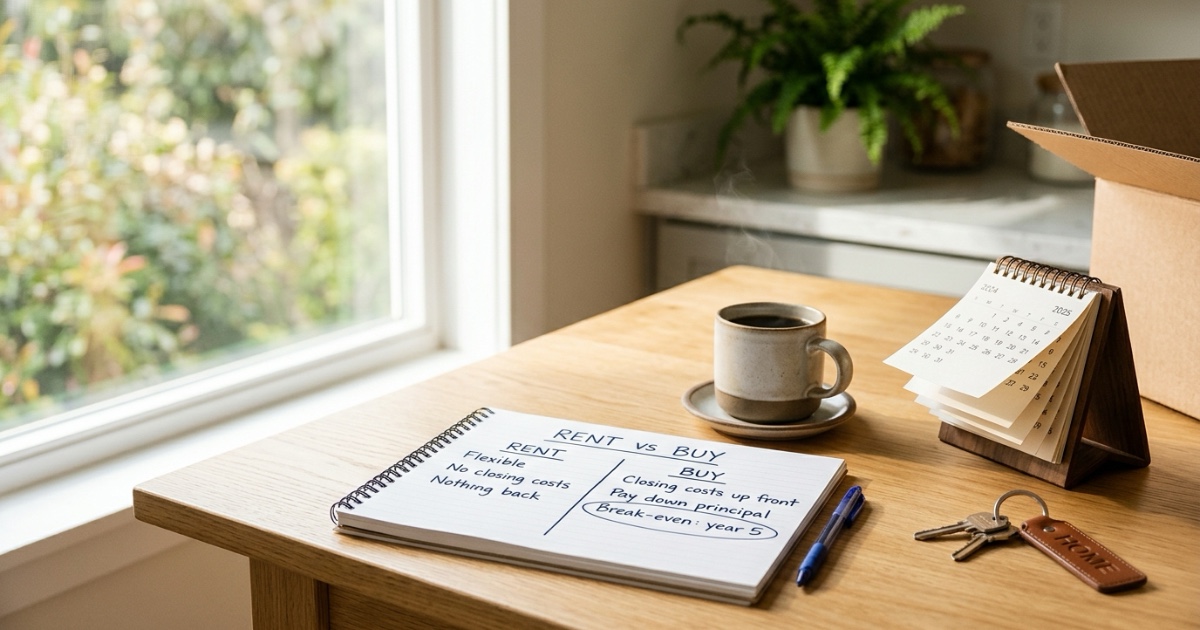
How Long Do You Have to Stay for Buying to Beat Renting?
Most rent versus buy advice fails for the same reason: it answers a question you didn’t ask.
You asked “should I buy?” and someone hands you a yes or a no. But there is no yes or no. There’s only “it depends,” and the thing it mostly depends on is one variable almost nobody puts at the center of the conversation.
How long are you staying?
Change that one number and the entire answer flips. Two years and buying is usually the worse financial move, even in a good market, even with a great rate. Seven years and it’s usually the better one. Same person, same house, same payment. Different answer.
So instead of arguing about which one is smarter, here’s where the line actually sits and what pushes it in either direction.
Buying front-loads the costs. Renting spreads them.
This is the whole mechanism, and once you see it the rest follows.
When you rent, your costs arrive in even monthly slices. Deposit, rent, renters insurance, done. When you leave, you pay to move and that’s the end of it.
When you buy, a large chunk of your cost hits before you’ve slept there one night. Down payment, lender fees, title, inspection, appraisal, prepaid taxes and insurance. Buyer closing costs commonly run somewhere in the range of 2 to 5 percent of the purchase price, on top of the down payment. Then there’s a second bill waiting at the other end: when you sell, commissions and seller costs typically take another chunk off the top.
The shape of every purchase
Day one
You're in the hole
Down payment, closing costs, inspection, appraisal. Real money renting would never have asked you for.
The middle years
You're climbing out
Each payment knocks down a piece of what you owe. If the property gains value, that helps too.
Break-even
Buying pulls ahead
From this point forward, staying put is what pays. It arrives in years, not months.
Sell before the line and you've paid both sets of costs and collected neither payoff.
So on move-in day, you are behind. Not a little behind. Everything after that is climbing back out, and that crossover point is your break-even.
The costs each side actually carries
An honest comparison puts both columns on the table. Most don’t.
Renting really costs you:
- Rent, which typically rises at renewal
- Renters insurance
- Moving costs each time you go
What renting gives back at the end: nothing. Rent evaporates.
Buying really costs you:
- The down payment (recoverable, but locked up and not earning elsewhere)
- Closing costs, which are not recoverable
- Principal and interest, where the early years are interest-heavy
- Property taxes
- Homeowners insurance, which in Florida deserves its own line item and its own quote before you fall in love with a house
- Maintenance and repairs, which a common rule of thumb puts near 1 percent of the home’s value per year
- HOA dues, if applicable
- Selling costs when you exit
What buying gives back at the end: the principal you've paid down, plus any appreciation, minus what it costs to sell.
Closing costs, interest, taxes, insurance, and repairs evaporate the same way rent does. Only the principal comes back.
That’s a narrower advantage than the “stop throwing money away” crowd implies. It’s also a real one, and it grows every year you stay put.
What actually moves your break-even
Here’s where you get some control. These are the levers that move your break-even year, either earlier or later.
Break even sooner
Fewer years before buying pays off
- A low rate, which sends more of each payment to principal from the start
- A low-cost purchase, including seller or lender credits that shrink your out-of-pocket
- Rent in your area that climbs quickly, which makes the thing you're comparing against get worse every year
- A property that needs little work
- A payment you can comfortably carry, so you're never forced to sell early
Break even later
More years before buying pays off
- A high rate combined with a high price
- Low or no down payment, which means slower principal paydown and mortgage insurance on top
- High HOA dues, high insurance, or a house with deferred maintenance waiting for you
- A flat or falling market during your holding period
- Any real chance you move within a couple of years
Read those lists again and notice something: most of them are knowable before you buy. This isn’t a coin flip. It’s a set of inputs you can go find.
Three honest answers, depending on you
Almost regardless of the market. You won't have time to climb out of the closing-cost hole, and forcing a sale on someone else's timeline is where people actually lose money on real estate. Flexibility is worth paying for and you're right to buy it.
The real gray zone, where your inputs decide it. Rate, closing costs, HOA, insurance, and how fast rent is moving in your area. This is the case where running actual numbers beats any rule of thumb, because a reasonable version of this scenario can land on either side.
If the payment fits your budget, the math usually favors buying, and it keeps favoring it more each year you stay. The rent side of the comparison keeps getting more expensive while a fixed payment mostly holds. Time is doing the work.
There’s also the part that isn’t math. Some people want to paint a wall without asking. Some people want to hand back the keys and go. Both are legitimate. Just know which one you’re paying for.
What to do this week
Skip the calculators for a second and go get four real numbers.
Fill in the blanks
-
1
Your current rent, and what it was two years ago
That's your actual trend, not a national average.
-
2
A rough all-in monthly payment for the kind of place you'd buy
Taxes, insurance, and HOA included. Not just principal and interest, because that number is always misleadingly small.
-
3
Your honest cash-to-close
Down payment plus closing costs, in one number.
-
4
Your best guess at how long you'd stay
The one that decides the other three.
With those four, you’re no longer having an opinion argument. You’re doing math, and math can be checked.
Answer the timeline question first
Rent versus buy stops being a debate the moment you’re honest about how long you’re staying. Everything else is inputs you can go collect this week.
If you’ve been circling this for a while and can’t tell whether you’re the two-year person or the seven-year person, that’s usually less about the market and more about not having a clear read on where you stand. The free readiness quiz gives you that read in about three minutes: income, savings, credit, timeline. Ready now, a few months out, or better off building a foundation first are all real answers, and knowing which one you are beats guessing.