Your Neighborhood Has a Supermarket. Does It Have Anything Else?
Every home for sale is in a convenient location.
Convenient to what?
Nobody ever says. So I built the tool that answers it.
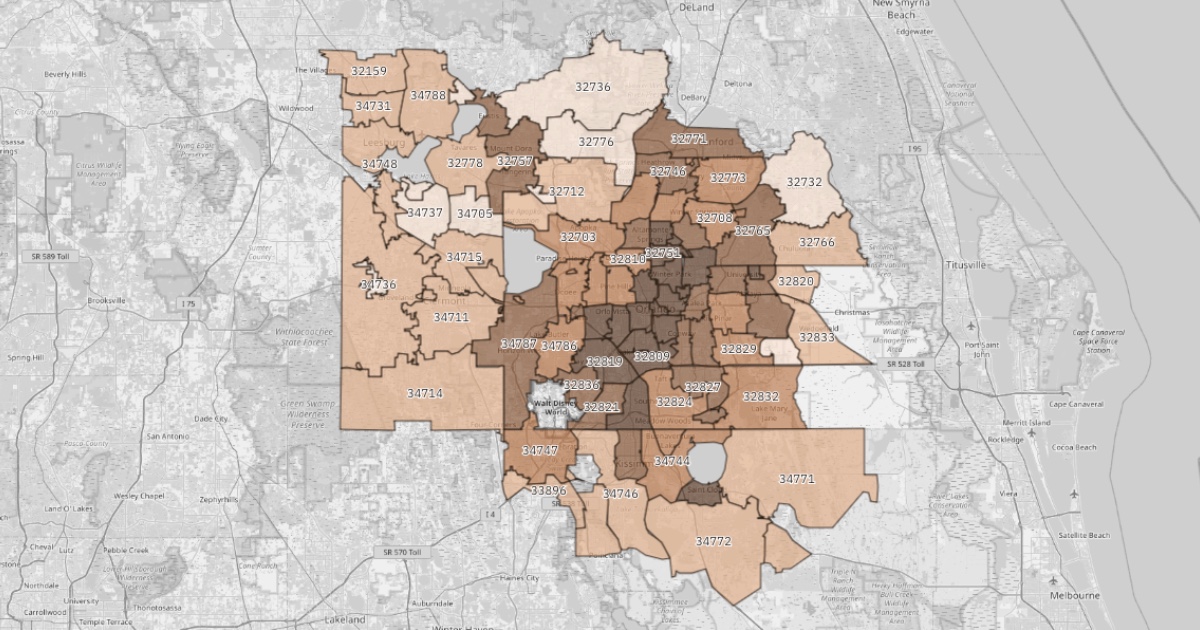
I wrote software before I sold real estate, and “convenient to what” is a software problem. So I made Orlando Amenity Score. It scores all 91 ZIP codes in Orange, Seminole, Osceola and Lake counties on how close you actually are, across eight categories.
Those eight fall into two groups.
Essentials, the four you cannot run a household without: groceries, schools, healthcare and shopping. Lifestyle, the four that decide whether you like living there: coffee shops, restaurants, parks and entertainment.
I built it, I maintain it, and I refresh the data every month.
Then I put all 91 ZIP codes side by side and read the two groups against each other, which I had never done. The answer surprised me.
The Snapshot Behind This Post
Captured September 6, 2026. Every figure in this post comes from that one snapshot.
Central Florida solved the grocery run and stopped there.
You Are Going to Drive. The Question Is How Much.
Walk Score and the tools like it measure one thing: whether you can avoid driving.
Here, that rates almost everywhere badly, which files a walkable pocket of Winter Park and an empty stretch of Lake County under the same verdict. True, and useless. It tells a buyer nothing they can act on, because nobody moving to Central Florida is choosing between a car and no car.
The question that is actually open to you is different. Given that you will drive, how much driving does this place ask of you?
So every category gets a tolerance radius. That is how far that kind of place can sit before the distance changes how you live.
- Groceries
- 1.5 mi
- Schools
- 2.0 mi
- Healthcare
- 3.0 mi
- Shopping and Hardware
- 3.0 mi
- Coffee Shops
- 1.0 mi
- Restaurants
- 1.0 mi
- Parks and Trails
- 1.0 mi
- Entertainment and Fitness
- 2.0 mi
Read that ordering carefully, because it is tolerance, not trip frequency.
The school run is the most frequent trip on the list, and schools sit at 2.0 miles, wider than groceries at 1.5. That is not a mistake. You choose a school once, then drive to it whether it sits half a mile away or two. You choose a coffee shop again every single time, and you quietly stop choosing the one a mile and a half out.
One more thing before the numbers. Every distance here is a straight line, not the road you would drive. Nothing on the list is over three miles, so the two are usually close. Minutes would need speed and traffic, which the data does not have.
The Four Things Central Florida Is Short On
Rank the eight categories by the share of the metro’s residents whose ZIP code averages farther away than that category is worth driving.
The four lifestyle categories take the top four spots. The four essentials take the bottom four. There is no overlap in the middle.
Share of the metro's 2.64 million residents, by category.
Coffee is the outlier and the headline. 61 of the 91 ZIP codes average more than a mile from a coffee shop. That covers 2,053,607 residents, or 77.8% of the metro.
At the other end, schools reach all but 2.4% of residents inside their tolerance.
Every essential category clears its own bar for at least 89% of the metro. No lifestyle category clears its own bar for even 86%. The worst essential still beats the best lifestyle.
The score itself tells the same story. The median ZIP code scores 27 on coffee. It scores 70 on schools and 70 on shopping.
The infrastructure of daily necessity got built. The infrastructure of a Saturday did not.
Here is the fair objection: I picked those radii, so of course they produce this result.
Three answers. I set the radii when I built the tool, long before I measured any of this, and I publish every one of them on the methodology page. They are identical in all 91 ZIP codes. And the ranking survives without them, on the raw distances alone: the median ZIP code sits 1.39 miles from a coffee shop and 0.75 miles from a school.
That is the whole finding in one line. The median ZIP code sits at 59% of its healthcare tolerance and 139% of its coffee tolerance.
Where the Gap Actually Lands
Categories are abstract. Places are not.
Across all 91 ZIP codes, essentials outscore lifestyle in 74 of them. Lifestyle leads in 15. Two are tied. The median gap is 10 points and the widest is 25.
Narrow it to the ZIP codes where the gap is 15 points or more and you get 28 of them. They hold 985,792 residents, 37.4% of the metro.
These are not the thin edges of the map.
The twelve most populous ZIP codes with a 15-point or wider gap. Both scores on the same scale, zoomed to 25 through 85.
See All 28 ZIP Codes With a 15-Point Gap or Wider
| Area | ZIP | Population | Essentials | Lifestyle | Gap |
|---|---|---|---|---|---|
| Clermont | 34711 | 67,980 | 60 | 45 | +15 |
| Orlando · South Semoran | 32822 | 64,120 | 71 | 52 | +19 |
| Orlando · Alafaya | 32825 | 61,755 | 66 | 48 | +18 |
| Kissimmee · Gateway | 34744 | 59,232 | 65 | 43 | +22 |
| Orlando · Meadow Woods | 32824 | 57,412 | 65 | 46 | +19 |
| Kissimmee | 34741 | 56,454 | 75 | 60 | +15 |
| Apopka | 32703 | 54,805 | 69 | 51 | +18 |
| Orlando · Pine Hills | 32808 | 52,551 | 64 | 49 | +15 |
| Apopka · Errol Estates | 32712 | 50,085 | 57 | 37 | +20 |
| Ocoee | 34761 | 48,193 | 65 | 49 | +16 |
| Orlando · Hiawassee | 32818 | 48,052 | 63 | 44 | +19 |
| Leesburg | 34748 | 45,481 | 49 | 34 | +15 |
| Kissimmee · Poinciana | 34758 | 43,282 | 52 | 28 | +24 |
| Kissimmee · Buenaventura Lakes | 34743 | 38,454 | 67 | 50 | +17 |
| Altamonte Springs · Forest City | 32714 | 38,049 | 73 | 56 | +17 |
| Orlando · Lockhart | 32810 | 35,925 | 64 | 45 | +19 |
| Orlando · Conway | 32812 | 34,586 | 69 | 54 | +15 |
| Orlando · Azalea Park | 32807 | 34,384 | 75 | 60 | +15 |
| Altamonte Springs | 32701 | 23,265 | 78 | 60 | +18 |
| Lady Lake | 32159 | 22,067 | 55 | 39 | +16 |
| Sorrento · Mount Plymouth | 32776 | 12,456 | 40 | 15 | +25 |
| Fruitland Park | 34731 | 12,078 | 49 | 26 | +23 |
| Orlando · Bithlo | 32820 | 10,150 | 50 | 33 | +17 |
| Mascotte | 34753 | 6,657 | 30 | 14 | +16 |
| Gotha | 34734 | 4,166 | 75 | 53 | +22 |
| Zellwood | 32798 | 2,501 | 43 | 20 | +23 |
| Intercession City | 33848 | 1,085 | 39 | 19 | +20 |
| Okahumpka | 34762 | 567 | 37 | 20 | +17 |
Sorted by population, the top of that list reads: Clermont with 67,980 residents. South Semoran with 64,120. Alafaya with 61,755. Kissimmee Gateway with 59,232. Meadow Woods with 57,412.
Those are the subdivisions Central Florida spent twenty years building.
Take Kissimmee Gateway. 59,232 residents, 65 on essentials, 43 on lifestyle. You can get anything you need for an errand. There is close to nothing for an evening.
Errol Estates in Apopka tells the same story twenty points wide: 50,085 residents, 57 against 37.
Every County Has It
This is not one county’s problem.
Counties ordered by median essentials score.
Scored 0 to 100. Every county shows the gap. Seminole's is the widest at 11 points.
The median gap runs from 7 points in Orange to 11 in Seminole. Seminole has the highest essentials median in the metro and the widest median gap in the metro at the same time.
Lake is the low outlier on both counts. Its 23 ZIP codes hold 372,968 people, so that is not a rounding error at the edge of the map.
One reading to resist: that Orange wins because it is the urban county. Orange has the narrowest gap because its lifestyle score is the highest of the four, not because its essentials are worse.
The Exceptions, Including the Awkward Ones
Fifteen ZIP codes invert the pattern. Lifestyle beats essentials. They fall into two groups that could not be more different.
Two invert it for the reason you would hope. Downtown Orlando scores 82 on essentials and 89 on lifestyle. Lake Nona scores 62 and 68. Baldwin Park (75 and 78) and Celebration (56 and 60) do the same thing, and both are master-planned. Somebody drew those places on purpose. That is the finding restated, not contradicted.
The rest invert it because they have almost nothing at all.
Paisley in Lake County scores 8 on essentials and 26 on lifestyle. Nothing there is convenient. It sits against the Ocala National Forest, so parks and trails is the one category it registers on, and a forest is a real amenity that is not a substitute for a pharmacy. Kenansville scores 0 and 2.
So a lifestyle score above an essentials score means one of two completely different things. The overall score is what tells you which, because the tool weights by area type and leans on essentials in the thin places.
One tick per ZIP code. Overlapping ticks read as darker.
The lifestyle distribution sits bodily to the left of the essentials one. The best lifestyle score in the metro (89, downtown) beats the best essentials score (83), so the ceiling is fine. The middle is the problem.
What This Does Not Measure
The score has four limits. Each one changes how you read every number above.
Not walkability.
The score assumes a car and measures how much driving a place asks of you. It says nothing about sidewalks, crossings or whether the walk is any good, and it never turns a distance into minutes.
Not a national ranking.
Scores are relative to this metro. "Bottom fifth" means bottom fifth of Central Florida and says nothing about anywhere else. There are no ratings, reviews or star counts in the data at all.
A ZIP code is coarse.
Sample points inside a single ZIP code differ by 26 points at the median, and by 66 in Four Corners. The ZIP figures are population-weighted averages.
OpenStreetMap is volunteered.
Coverage is uneven, and a thin rural score is partly a mapping artifact rather than an empty landscape.
It also says nothing about crime, cost, traffic, flood risk or school quality. It is a proximity measure, and that is all it is.
What to Do With It
Of those four limits, the coarse ZIP code is the one that matters most to you.
In Four Corners the sample points run from 5 to 71. One ZIP code, a 66-point spread, and a single average sitting on top of it hiding exactly what you wanted to know.
Which is the argument for looking up the address instead of the ZIP code. Two houses a mile apart in the same suburb can sit on opposite sides of this entire finding.
So before you fall for a listing, go type its address into Orlando Amenity Score. You will see all eight category scores for that exact spot instead of the ZIP code average. Free, no signup.
Amenity data © OpenStreetMap contributors. Population and geography from the 2020 US Census. Snapshot captured September 6, 2026.