Buying When You're Self-Employed or 1099 in Orlando
Here’s the worry I hear from self-employed buyers more than almost any other: “I make good money, but it’s all 1099. Can I even get a mortgage?” The short answer is yes. People do it in Orlando every month. The longer answer is the one that actually helps: the hold-up is rarely how much you earn. It’s how a lender reads what you earn.
Why a self-employed file gets read differently
A W-2 employee hands over a pay stub and a couple of years of W-2s, and the income question is mostly settled. When you’re self-employed or paid on 1099s, there’s no single stub to lean on. The lender reconstructs your income from your tax returns, and the number they land on is often lower than the number in your head.
That gap is the whole story. The figure you think of as your income is usually what your business brings in, or what hits your account. The figure a lender uses is what’s left after the deductions you take on your return. Understanding why that’s true, before you apply, is the difference between a clean pre-approval and a frustrating one.
The income you think of as yours is what the business brings in. The income a lender counts is what's left after your deductions.
That gap is the whole story. Know it before you apply and a low qualifying number stops being a surprise and starts being something you planned for.
How a lender turns your returns into a qualifying number
Start with the rule that surprises people most: lenders generally qualify you on your net income, not your gross. Revenue matters far less than what’s left after expenses. The same write-offs that lower your tax bill (the home office, the mileage, the equipment, the depreciation) also lower the income a lender counts, because your taxable income is exactly where an underwriter starts.
A few mechanics shape the final figure:
Lenders average your net income across the last two tax years rather than rewarding one strong stretch. Most conventional loans follow Fannie Mae's guidelines here.
Paper costs like depreciation and depletion get added back, raising the income a lender counts above your bottom-line taxable number.
If your most recent year is lower than the year before, many lenders skip the average and use the lower, more recent figure. FHA files can need a closer manual review. The exact treatment depends on your loan and lender.
Expect to provide a current-year profit and loss statement. If this year is pacing well below your two-year picture, that slower pace can become the number they use.
None of this is a judgment on your business. It’s the method lenders use, and once you know it, you can plan for it instead of being surprised by it.
The two-year history rule, and where it bends
The common expectation is a two-year history of self-employment, on the logic that two years shows the income is stable and likely to continue. That’s the norm, not an ironclad law.
There’s a real exception. Under Fannie Mae’s guidelines, a shorter history (as little as a full 12 months in your current business) can work when two things are true: your most recent signed personal and business returns show that full year, and you can document prior experience in the same field at a similar or higher income. Someone who spent years as a salaried graphic designer and then went freelance doing the same work has a stronger case than someone who changed careers entirely.
Whether that exception applies to you depends on your loan type and the lender, so treat it as a conversation to have, not a box you’ve already checked.
The documents to gather before you apply
Self-employed files are document-heavy by nature, and getting organized early is the single biggest thing you can do to make pre-approval go smoothly. Have these ready before you talk to a lender:
Your pre-approval folder
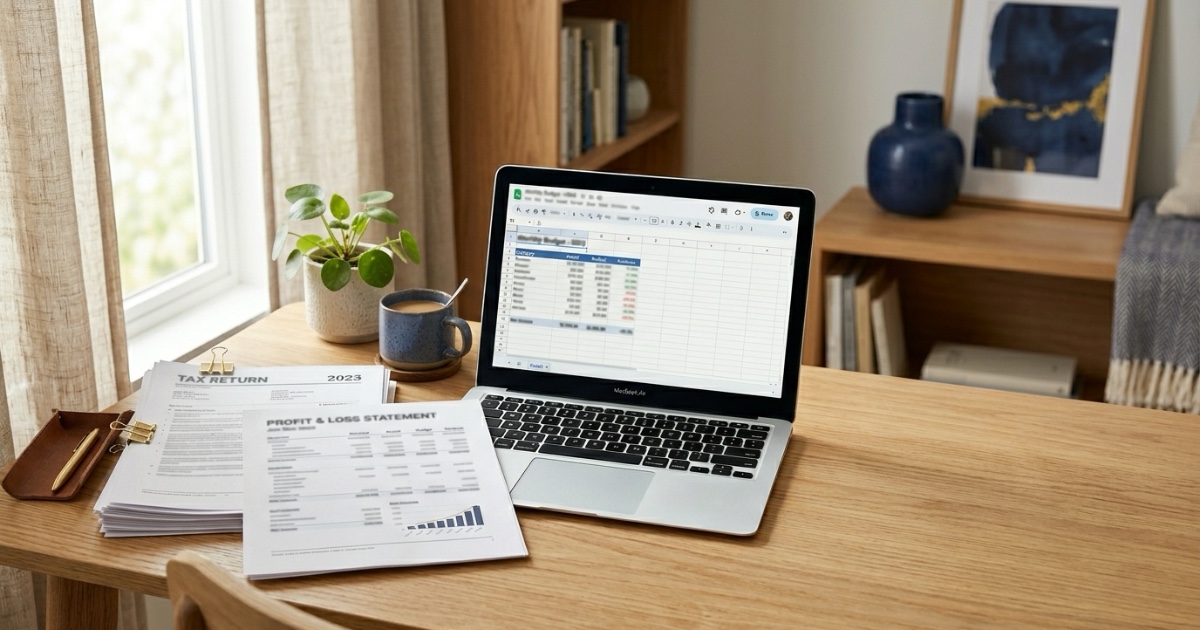
- Two years of personal tax returns, complete with every schedule. Your Schedule C or business pages are where net income lives.
- Two years of business tax returns, if your business files separately from your personal return.
- A year-to-date profit and loss statement. Applying more than a quarter past last tax year? Add a current balance sheet too.
- Business and personal bank statements, which the lender uses to confirm deposits and the cash you'll bring to closing.
- 1099s from your clients or platforms, for the relevant years.
- A business license or CPA letter, confirming the business is active and yours.
Having all of this in one folder does two things: it speeds the file up, and it signals to the underwriter that you run an organized business. That’s its own quiet form of credibility.
Why pre-approved beats pre-qualified, especially for you
For a W-2 buyer, the gap between a pre-qualification and a real pre-approval is meaningful. For a self-employed buyer, it’s close to the whole game.
A quick estimate from a number you give the lender. Built on a gross or gut figure, it can come apart the moment an underwriter opens your returns, sometimes after you're already under contract.
The lender collects your documents and an underwriter reviews your real qualifying income. Not a guarantee, but a backed figure your file already supports, and one you can shop with.
A pre-qualification is a quick estimate based on what you tell a lender. Say “I make $120,000” and a pre-qual takes it at face value. But once an underwriter averages your net income and works through the add-backs, your qualifying figure can land well below that. A pre-qual built on a gross or gut number can come apart the moment someone opens your returns, sometimes after you’re already under contract on a house.
A pre-approval is the reverse. The lender collects your documents, an underwriter reviews your actual qualifying income, and the number you get is one your file already supports. It isn’t a guarantee, but it’s a real, backed figure you can shop with. For self-employed buyers, knowing that number early is worth it even when it’s lower than you hoped, because it’s the number that’s actually true. I went deeper on that distinction in the pre-approval versus pre-qualification breakdown; it’s worth reading before you apply.
A few honest ways to strengthen your file
You can’t, and shouldn’t, rewrite your tax returns to chase a mortgage. But a few honest moves make a self-employed file stronger:
Clean, separate business and personal accounts make your deposits easy to source and the whole file easier to read.
There's a real tradeoff between maximizing write-offs and showing enough net income to qualify. Have that talk before your next return is filed, not at the application. The goal is an accurate picture, not a number bent to fit.
You'll need it for the file anyway, and watching it through the year tells you where your qualifying income is heading.
A large equipment loan or a new line of credit taken on in the months before you apply can change how your file reads.
Show up with the real number
Being self-employed isn’t the obstacle first-timers fear it is. The obstacle is showing up with a gut income figure and someone else’s idea of what you qualify for. Show up instead with two years of organized returns, a current profit and loss statement, and a real pre-approval, and you’re shopping with confidence rather than hope.
If you want to see where you stand before any of that, the free readiness quiz gives you a straight read in about three minutes (income, savings, credit, timeline), and the 10-step roadmap lays out the buying process in order. But the real next step is simple: get your two years of returns and a current P&L into one folder, then take them to a loan officer who can turn them into your true number. That’s the number worth planning around.