Why Pre-Qualification Isn't Enough for a Competitive Orlando Offer
Two words get used like they mean the same thing, and they don’t: pre-qualified and pre-approved. In a quiet market with little competition, the difference is academic. In a competitive offer, it can be the reason a seller reads your offer instead of setting it aside. Small in conversation, large on a contract.
Pre-qualified vs pre-approved: the actual difference
A pre-qualification is an estimate built on numbers you report. You tell a lender your income, your debts, and your savings, and they hand back a ballpark of what you might borrow. Nothing has been verified. It’s a fine way to set your own budget, and that’s about as far as it goes.
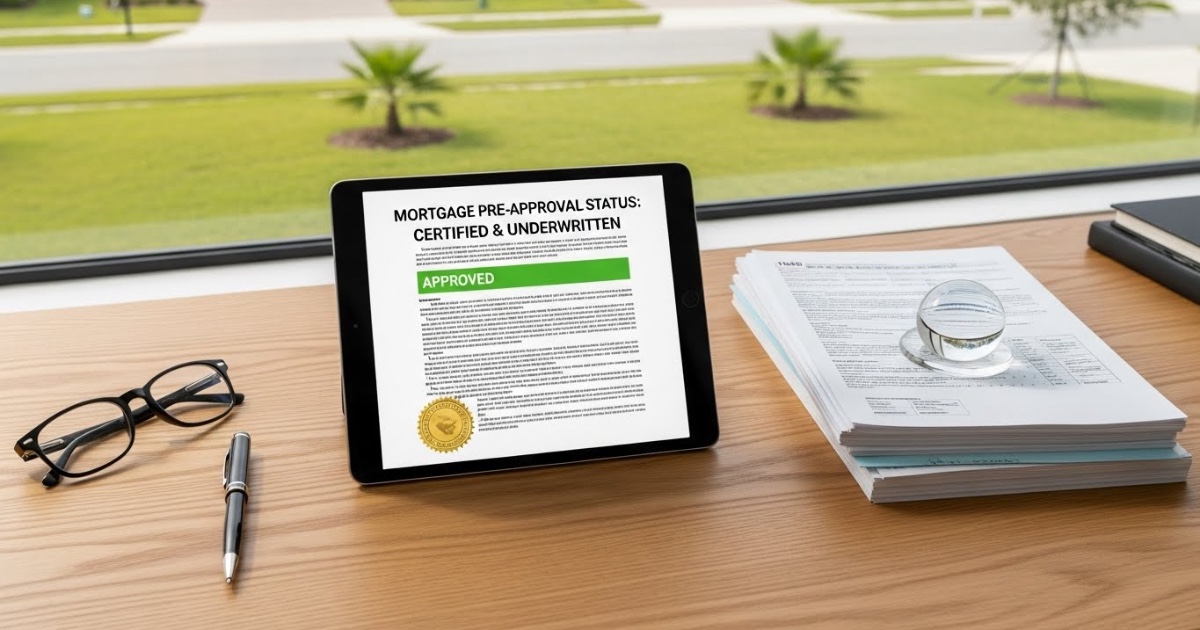
A pre-approval is the lender’s review of your verified documents. They collect proof of your income, your assets, and your credit, an underwriter or loan officer works from the actual files, and you get a specific amount your paperwork supports. It carries weight because someone actually looked.
One caution worth saying plainly: a pre-approval is not a guaranteed loan. It’s a strong, evidence-backed read on what you can borrow, but the final approval still depends on the property, the appraisal, the title, and any conditions the lender lists. It removes most of the uncertainty, not all of it.
Three rungs on the readiness ladder
Readiness isn’t on or off. Think of three rungs, each one more convincing to a seller than the last.
- Pre-qualification. Self-reported, nothing verified, a soft credit check at most. Quick, often just minutes, and the weakest signal to a seller.
- Pre-approval. Your documents reviewed and your credit pulled with a hard inquiry. A real, backed number, and the practical baseline for making offers.
- Fully underwritten pre-approval. An underwriter reviews your full file up front, before you’ve even found a house. With most of the financing questions already answered, mainly the appraisal and title remain. To a seller, that reads close to a cash offer.
A quick comparison:
| Pre-qualification | Pre-approval | Fully underwritten | |
|---|---|---|---|
| Based on | What you report | Verified documents | Underwriter review up front |
| Credit check | Soft, or none | Hard pull | Hard pull |
| Typical time | Minutes | A day or two | Several business days |
| Seller’s read | Low confidence | Solid | Strongest, near cash-like |
The fully underwritten option isn’t offered by every lender and goes by different names, so ask whether it’s available rather than assuming it. When you’re competing for a house, moving up even one rung changes how your offer lands.
Why an Orlando seller reads past your price
Sellers are cautious for a practical reason: a deal that falls apart is expensive. When a home goes under contract and then comes back on the market because the buyer’s financing collapsed, it tends to draw lower offers the second time around. Buyers assume something is wrong with it, even when the answer is nothing.
So when a listing agent lays out competing offers, “highest and best” isn’t only the top-line number. It’s about which offer is most likely to actually close. With the Orlando median sale price at $410,774 in April 2026, and single-family homes at $440,119 (per the Orlando Regional REALTOR® Association, using Stellar MLS data), a failed contract puts real money and weeks of time back at risk. Certainty is worth a lot to the person on the other side.
A worked example: the lower offer that can win
Picture two offers on the same house, listed around the local single-family median. (These figures are illustrative.) One buyer is pre-approved and offers $440,000. The other is only pre-qualified and offers $450,000. On price alone, the second buyer looks better by $10,000.
But the seller isn’t only buying a price, they’re buying a closing. The pre-approved offer has verified documents behind it. The pre-qualified one rests on numbers nobody has checked, and it could unravel once an underwriter opens the file, possibly weeks into the contract. For many sellers, $10,000 isn’t worth that risk. The stronger paperwork wins, and the buyer who looked cheaper gets the house.
What a pre-approval actually requires
Getting pre-approved means handing the lender a real file. Expect to provide:
- Two years of W-2s and your most recent pay stubs (or, if you’re self-employed, two years of tax returns).
- Two months of statements for your checking, savings, and investment accounts.
- Two years of federal tax returns.
- Permission for a credit report, which is a hard inquiry.
If your income comes from 1099 work or your own business, the file looks a little different, and the way a lender reads variable income trips up more first-time buyers than almost anything else. I walked through exactly how that works, and how to prepare for it, in buying when you’re self-employed or 1099 in Orlando. Being self-employed isn’t a barrier. It just means showing your income a different way.
The non-mortgage costs a lender now weighs
Your mortgage payment isn’t only principal and interest. Property taxes and homeowner’s insurance are escrowed into it, and lenders fold both into the debt-to-income math behind your pre-approval. In Florida that matters more than it used to, because insurance has climbed. Premiums vary widely by home and coverage, but a few thousand dollars a year is a realistic planning number for Orlando, roughly $3,000 to $4,800 for around $300,000 in dwelling coverage, based on 2026 market data. A real pre-approval accounts for taxes and insurance before you fall for a house, so the payment you picture is the one you’ll actually carry. These figures move quickly, so confirm current numbers with a licensed insurance agent and your loan officer.
How to move up the ladder before you shop
You don’t need to game anything to look stronger. A few steps, in order, before you start touring homes:
- Check your credit and fix real errors. Pull your reports and correct genuine mistakes, like an account that isn’t yours or a balance that’s wrong. Give it a few months, since corrections take time. This is about accuracy, not disputing items that are correct.
- Keep your income and employment steady. Lenders look for continuity through the process, so the months before you apply aren’t the time for a major job change if you can avoid it. (If you’re already self-employed, that’s fine, see the post above on how that income is read.)
- Season your down payment. Have your down-payment and closing-cost funds sitting in your accounts for a couple of months before you apply, so the money is easy to source and doesn’t trigger extra questions.
- Get a real pre-approval letter. Work with a lender who has a track record of closing on time, and have a property-ready letter in hand so you can move the day the right house appears.
Certainty is what wins the offer
In a market where buyers have a little more room than they did a couple of years ago, it’s tempting to think the pressure is off. The offer you write still has to convince a cautious seller, and the surest way to do that is to remove their doubt about whether you’ll close. Pre-qualified tells them you did some math. Pre-approved tells them a lender checked your documents. Fully underwritten tells them an underwriter already reviewed your file. Each rung answers more of the seller’s real question: will this actually close?
Handle that part before you shop, and your offer competes on strength, not on price alone. If you want the whole buying process laid out in order, the free 10-step roadmap walks it step by step, and the readiness quiz gives you a quick read on where you stand today. The paperwork just makes sure you can move when you find the one.