Why Pre-Qualification is No Longer Enough for a Competitive Offer in 2026
Defining the Scope: Pre-Qualification vs. Pre-Approval
The terms are often used interchangeably in casual conversation, but in a legal and financial context, they represent vastly different levels of vetting. A pre-qualification is a preliminary assessment based on unverified information provided by the borrower. It is an estimate of what you might be able to afford, lacking the weight of a formal credit decision.
In contrast, a pre-approval is a conditional commitment from a lender to grant you a mortgage. This process involves a rigorous evaluation of your financial history, including credit reports, income verification, and debt-to-income (DTI) ratios. In the current interest rate environment, where monthly carrying costs are significantly higher than historical averages, this distinction is the baseline for entry into the market.
The Mechanics of a Pre-Qualification
A pre-qualification is essentially a “soft” look at your finances. You provide a lender with your income, debts, and assets, and they provide a letter stating what you could potentially qualify for.
- Documentation: Minimal to none.
- Verification: No third-party verification of tax returns or pay stubs.
- Credit Impact: Usually involves a soft credit pull, which does not affect your score.
- Timeline: Can be completed in minutes.
While this is a helpful first step for a buyer to establish a personal budget, it carries little weight with listing agents managing competitive inventory across the region. Because the data is unverified, the risk of the loan falling through during the underwriting process is high, which creates unnecessary uncertainty for the seller.
The Depth of a Pre-Approval
A true pre-approval requires the buyer to submit a comprehensive financial package to the lender. This moves the “heavy lifting” of the mortgage process to the beginning of the transaction rather than the end.
Required Documentation for 2026 Standards:
- Income Verification: Last two years of W-2s and the most recent 30 days of pay stubs.
- Asset Statements: Last two months of statements for checking, savings, and investment accounts.
- Tax Returns: Usually the last two years of federal returns, especially critical for self-employed buyers in the burgeoning Central Florida tech and tourism sectors.
- Credit Report: A hard inquiry that provides a detailed look at payment history and existing liabilities.
Expert Insight: The Underwritten Pre-Approval
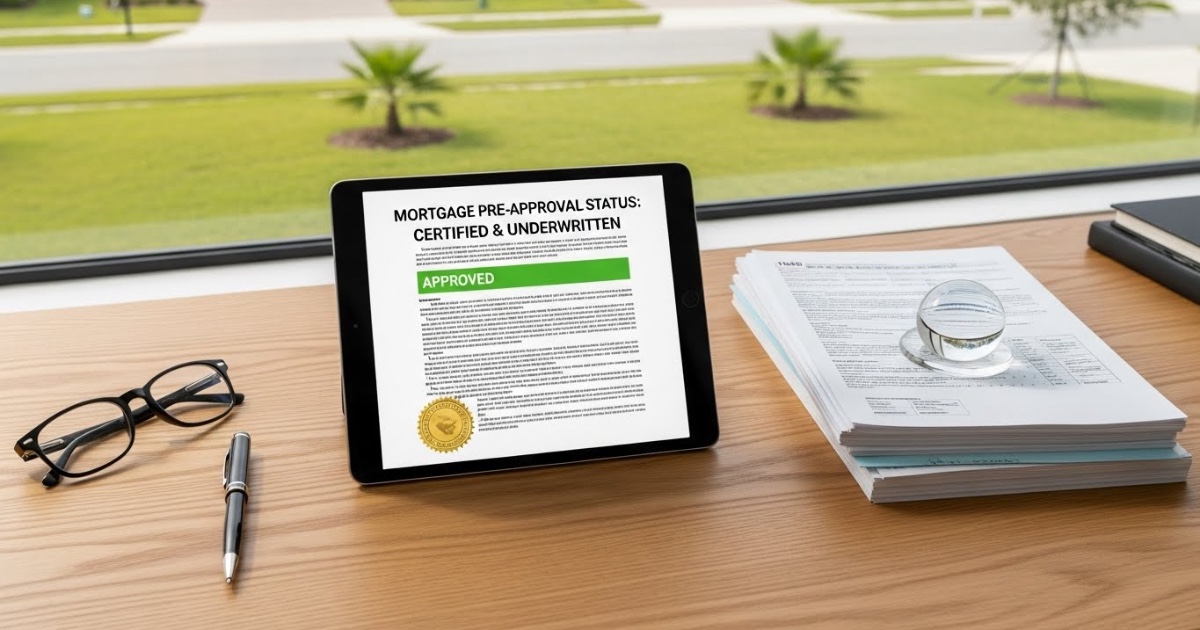
In high-demand markets where multiple offers are the norm, I recommend a “Fully Underwritten Pre-Approval.” This goes a step beyond a standard pre-approval because an actual underwriter, not just a loan officer, reviews your financial files upfront. This effectively turns your offer into a “cash-like” bid. It solves the mystery of whether or not you will get the loan, leaving only the property appraisal and the title search as variables. This gives sellers the ultimate peace of mind.
Mortgage Readiness Levels
1. Pre-Qualification
- Data Source: Self-reported financial info
- Credit Check: Soft pull (no impact to score)
- Seller Perception: Low confidence
- Processing Time: About 15 minutes
- Reliability: Low
2. Pre-Approval
- Data Source: Verified by a Loan Officer
- Credit Check: Hard pull
- Seller Perception: Moderate to high confidence
- Processing Time: 24 to 48 hours
- Reliability: High
3. Fully Underwritten Pre-Approval
- Data Source: Verified by an Underwriter
- Credit Check: Hard pull
- Seller Perception: High confidence (Cash-like offer)
- Processing Time: 3 to 7 business days
- Reliability: Absolute
Why Central Florida Sellers Prioritize Pre-Approval
Sellers in 2026 are risk-averse. With the median sales price in $440,000 reflecting sustained values, the cost of a failed contract is significant. If a home goes “Pending” and then returns to the market because the buyer’s financing failed, it carries a stigma that often leads to lower subsequent offers.
The Impact on Your Offer
When a listing agent in a competitive market receives multiple offers, they create a comparison spreadsheet for the seller. A buyer with only a basic pre-qualification is often moved to the bottom of the pile regardless of the offer price. Sellers are looking for the “highest and best” terms. In this context, “best” specifically refers to the certainty of the closing.
Practical Application: If you are bidding on a $550,000 home, a pre-approved buyer offering $550,000 will almost always beat a pre-qualified buyer offering $560,000. That $10,000 difference is rarely worth the risk of the deal collapsing three weeks into the escrow period.
Navigating the Financial Impact of 2026 Market Variables
In Central Florida, mortgage readiness must also account for rising non-mortgage housing costs. Lenders are now scrutinizing debt-to-income ratios more closely due to the spike in homeowners insurance premiums and property tax assessments.
- Insurance Considerations: Annual premiums in Orange and Seminole counties now average between $3,500 and $6,000. A pre-approval ensures these costs are factored into your DTI before you fall in love with a property.
- Property Taxes: For buyers looking at new construction in areas like St. Cloud or North Orange County, the “sticker shock” of reassessed taxes after the first year can be substantial. A pre-approval provides a realistic ceiling for your monthly payment that includes these escrowed items.
Strategic Steps to Mortgage Readiness
To position yourself as the strongest possible candidate, follow this sequence before beginning your physical home search:
- Audit Your Credit: Resolve any disputes or errors at least three months before applying.
- Stabilize Employment: Avoid changing jobs or moving from a W-2 position to 1099 status during the process.
- Consolidate Down Payment Funds: Ensure all funds for the down payment and closing costs are “seasoned” in your accounts for at least 60 days to avoid complex sourcing requirements.
- Obtain the Letter: Secure a property-specific pre-approval letter from a reputable lender who is known for hitting closing dates in the local market.
By completing these steps, you transition from a “looker” to a “buyer.” This preparation allows us to move aggressively when the right property hits the market, providing the seller with the confidence they need to sign your contract.